
Two magnetic charging pads both say 25W on the box. Ten minutes in, one is barely warm and the other is hot enough to notice. Most people blame the chip or the heatsink. The coil is the likelier suspect: at higher frequencies, copper stops using its full cross-section.
At 100kHz, Live Copper Is Only 0.2mm Deep
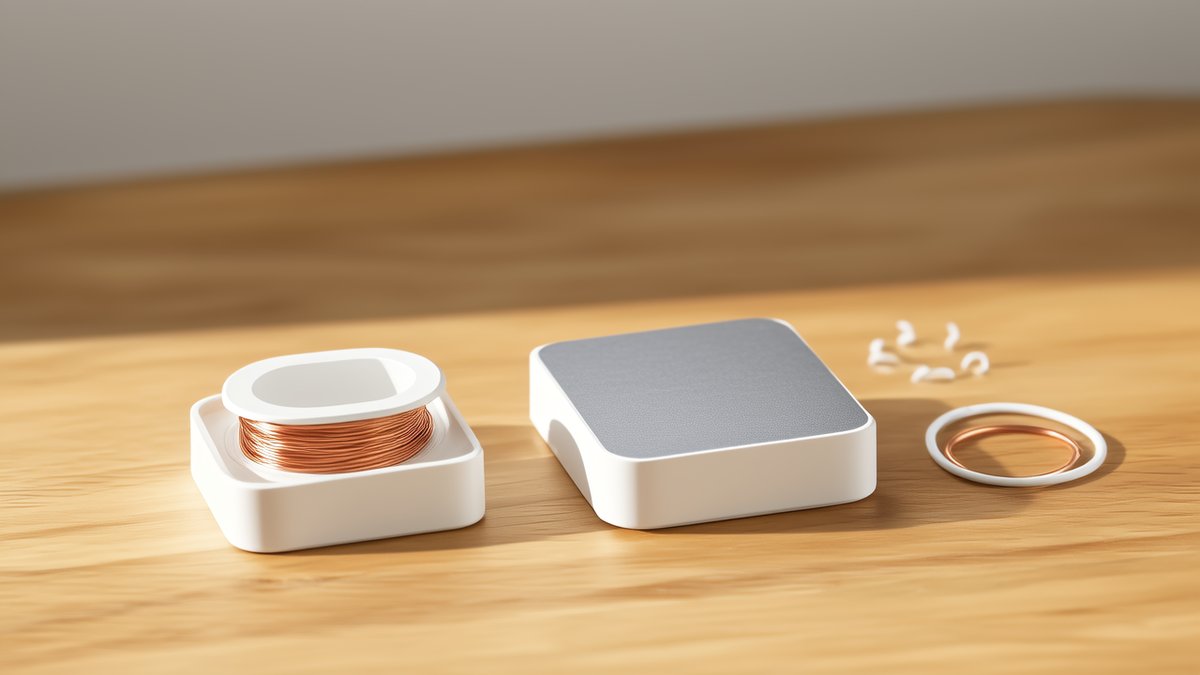
Qi runs between 87kHz and 205kHz. In that band, current crowds toward the surface of the wire and leaves the core idle. That is the skin effect. Coil supplier Golden Eagle puts copper skin depth in this range at roughly 0.1mm to 0.2mm, while LP Winding Wire calculates about 0.21mm at 100kHz. A solid 1mm enameled wire therefore does its real work in a thin outer shell while the middle is dead weight.
Proximity effect makes it worse. The closer the strands sit, the more each one's alternating field induces eddy currents in its neighbours. Splitting the wire is not enough on its own: twist pitch, stranding construction and whether the bundle is fully transposed all move the final loss figure. At the same cross-section, stranded wire cuts AC resistance 5 to 10 times versus single-strand enameled wire between 100kHz and 200kHz, according to Golden Eagle. Applied well at higher frequency and power, Litz construction can cut coil loss by 30% to 50%, and LP Winding Wire's comparison data lands in the same range.
High-Power Designs Have Already Moved to 63-Micron Strands
A March 2026 APEC paper from ORNL and the BMW Group (Aydin and co-authors) pushes the logic further. Working on an 85kHz, 22kW vehicle system, the team found Litz wire accounted for more than half of all system losses, so they optimised it directly. Strands of 63 microns clearly beat the conventional 100-micron build: copper volume dropped about 60% for the same loss, coil-to-coil efficiency rose more than two percentage points, and the full system reached 94.7%.
Consumer pads do not chase 22kW, but the rule holds, strand diameter has to sit below the skin depth. Receiver coils for earbuds, watches and phones commonly use 0.05mm to 0.1mm strands, in bundles from a few dozen to over a hundred. That gives buyers a practical test: ask the supplier for measured AC resistance, not just DC resistance. Copper DC resistance climbs about 16% between room temperature and 60C in Golden Eagle's measurements, so a cold reading is worth little. One more detail that gets skipped: Q has to be measured with the ferrite sheet attached, because the sheet lifts coil inductance 30% to 60%, which lets you use fewer turns with lower DC resistance and higher Q. A bare coil measurement tells you nothing.
Back to the pad that runs hot. Beyond feeling the surface, you can judge a 25W magnetic pad by how well it holds alignment. Good alignment raises the coupling coefficient, so the coil needs less current for the same output, and copper loss scales with the square of current. That saving shows up as temperature.
© SWPO. All rights reserved.