
Half of what makes a magnetic charger pleasant to use is grip, and half is temperature. Everyone competes on the first half, where one vendor lists 7N of holding force, another 1.2 kilograms of pull, and a review measures about 15N. Almost nobody talks about the second half, yet it decides whether the first half survives. The magnet is neodymium-iron-boron, and that material does not like heat. Push past its rated temperature and it loses strength for good.
Start with the grade. In a grade like N52, the number is the maximum energy product and the letter after it is the temperature class. Plain N carries no suffix and tops out around 80C. Add M and you reach 100C, H reaches 120C, SH reaches 150C, and UH and EH go higher. The most common mistake in sourcing is choosing N52 for the strongest field while the assembly sits next to a heat source running at 100-110C. That is outside the rating, and the flux starts to fall irreversibly. An N35 magnet exposed to 100C can permanently lose 5% of its remanence, while an SH grade takes 150C without that penalty.
Why the magnet in a charger really does get hot
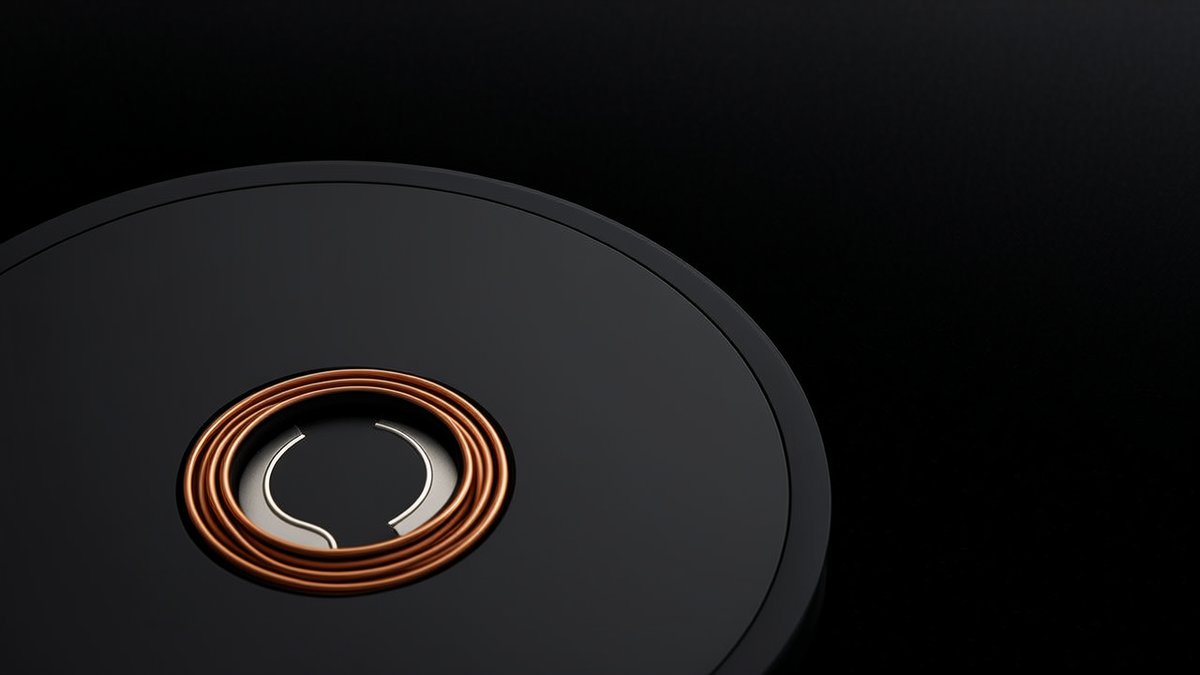
There is a common assumption worth correcting. Since a wireless charging surface is required to stay within 12C of ambient, the magnet must be sitting at thirty or forty degrees, so demagnetization is not a real concern. The problem is that the magnet is not at the surface. It sits below it. Heat from the transmitter coil, the ferrite shield and the control circuit all has to leave through that stack, and the ring of magnets behind the coil can run far hotter than the surface you can touch. The WPC thermal test governs the top surface of the test receiver, not the internal components. A cool surface does not mean a cool interior.
Two use cases make this worse. A dashboard in summer sun can push local temperatures well past 60C, and a magnetic power bank generates coil heat and cell heat at the same time. One supplier's published incoming inspection standard states it plainly: hold the unit at a constant 80C for 72 hours, cool it to room temperature, then measure pull force, and the loss must stay under 10%. That test exists specifically to catch irreversible demagnetization. Another test cycles between 60C and minus 20C five times for an hour each, and allows no more than 15% loss.
Temperature class costs money. N52H runs 15-25% above plain N52, N52SH runs 30-50% above, and both take longer to deliver because of the rare earth blend. A cheap magnetic product using a plain N grade is not automatically cutting corners. Often the specification never stated the operating environment, so the supplier quoted the cheapest option that met a vague brief.
Pull force numbers are not comparable, so ask three questions first
The second thing to puncture is the headline pull-force figure. One supplier rates N52H at roughly 420 grams of pull and N48 at roughly 350 grams. Another product lists sixteen N52 magnets and 1.2 kilograms of pull, which works out to about 11.8N. Those numbers cannot be lined up against each other, because pull force depends on grade, geometry, contact area and working air gap. A rule of thumb in the industry is that real assemblies lose 30-60% of the zero-gap datasheet value once air gap and surface flatness are accounted for. A case thicker than 3mm weakens the field further, and some vendors say plainly that an ordinary case degrades alignment and slows charging. That is why a stated maximum case thickness is a more useful spec than a stated pull force.
Another point of confusion is whether a weaker magnet means a broken product. Part of the loss from heat is reversible. The temperature coefficient of remanence for standard grades averages about minus 0.1% to minus 0.2% per degree, so an N42 running continuously at 80C may deliver only nine tenths of its room-temperature pull and recover fully once it cools. What does not come back is the portion above the rated limit. That loss persists and accumulates with repeated over-temperature events. So when a charger feels like it grips less after a couple of years, the magnet usually is not broken. The original specification simply never did the temperature math.
If you are sourcing or building, three questions cover most of the risk: which grade is used and does it carry a temperature suffix, what is the measured magnet temperature at full load in the finished product, and will the supplier share pull-force data after 80C ageing or thermal cycling. Sintered neodymium is brittle and behaves more like ceramic than steel, so press-fitting bare magnets tends to crack them, and heat plus humidity attacks the coating. Specifying mechanical retention or a high-temperature epoxy, and choosing epoxy or parylene coating over plain nickel-copper-nickel, are worth writing into the document. On inspection, measure pull force on at least three samples and take the median rather than trusting a single reading.
The bottom line: pick the magnet grade that matches the temperature it will actually see, not the strongest one on the list. An N48H at 80C will hold up better than a nominally stronger N52.
© SWPO. All rights reserved.