
AI glasses have been arriving thick and fast this year, and the spec sheets talk about cameras, translation languages and assistants. The thing you actually live with daily, charging, gets the least attention and produces the most regret. Four approaches coexist today, each with its own cost.
The most common is the charging case. The frames expose no charge port. Small contacts at the temple or bridge meet spring pins inside the case, and the case carries a larger battery topped up over USB-C. Ray-Ban Meta is the reference: up to 8 hours on the frames, about 5 hours with continuous audio and assistant use, plus roughly 48 more hours from the case and 50% in about 20 minutes. The catch is that the case is effectively the only path. The frames have no user-replaceable battery and no manufacturer-supported charging port, so a lost or broken case means the glasses run until the battery is empty. Ray-Ban did open official replacement parts in the US from August 2026, listing a replacement case at $99 with one per order. Do not assume a generic wireless charger, an ordinary glasses case or an improvised cable will do; the supported route is docking the glasses in their matching case.
A Wireless Charging Case Arrives
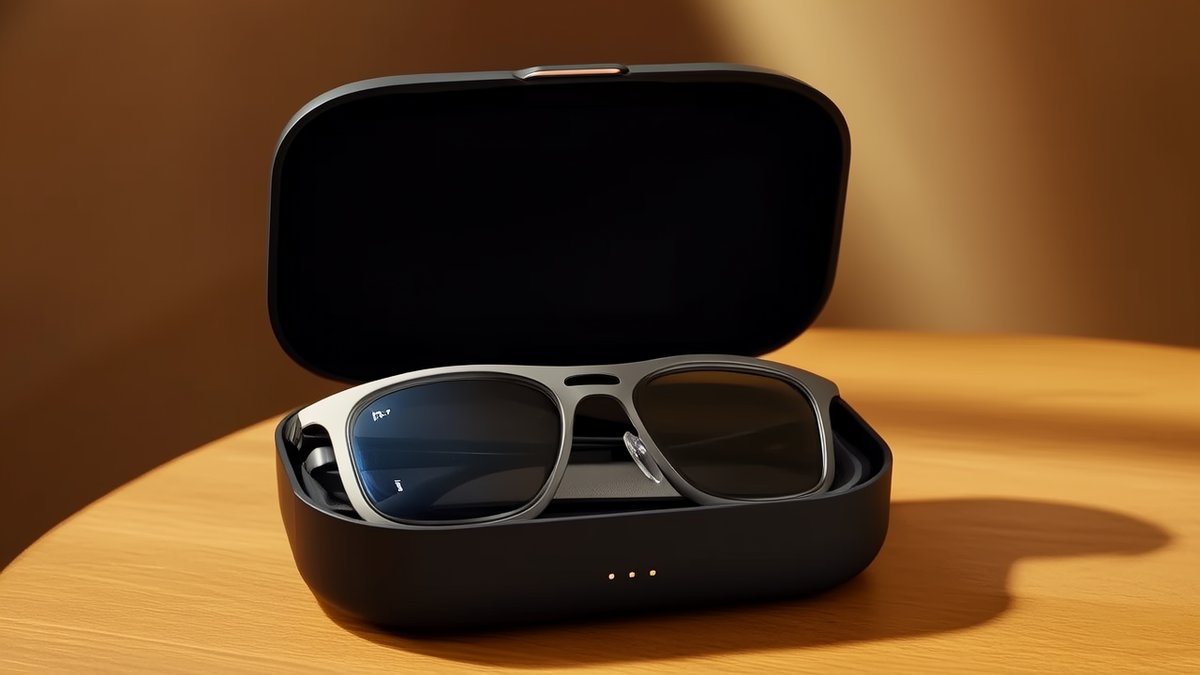
Samsung's Galaxy Glasses, launching in November, take another route: about 9 hours per charge on the frames, with a case that supports wireless charging and reportedly adds seven full charges. Higher up, Meta Ray-Ban Display pairs a 6-hour frame, which a reviewer measured down to 40% after 90 minutes of continuous audio and display use, with a folding case Meta rates for 24 more hours, and UploadVR measured closer to four full charges at about 30 hours. Both point the same way: as frames get lighter, the runtime ledger moves into the case.
Magnetic Contacts and Cables Still Have a Place
The second family uses magnetic charging cables: contacts inside the temple, a USB-A or USB-C plug at the other end, and one or two magnetic heads that snap on. The upside is not carrying a case, lighter and thinner frames, and less mechanical wear than a plug. The downside is that these cables are largely proprietary, so losing one on a trip is a real problem. The third family is straight USB-C, found on some modular AR glasses. The fourth is tethered power, used by display-first glasses such as XREAL, Rokid and RayNeo in fixed setups. Verizon with SPECS put 5G inside the charging case in September, turning the case from a battery into a network entry point.
Three questions are worth answering before buying: will you carry the case when you travel, in which case rule out case-only models if the answer is no; is the frame's water resistance enough for your day, given that IPX4 resists splashes only and contacts should be dried before docking; and can the accessories be bought separately. The first two decide the experience, and the last decides how many years the glasses last.
© SWPO. All rights reserved.