
Most people adding a wireless charger to a car start with the spec sheet: is it rated 15W or 25W? Two or three weeks later the annoyance turns out to have nothing to do with wattage. It is the phone sliding half a centimetre on a speed bump and cutting the charge, or the cabin baking in an open-air car park until the screen says charging has paused because the phone is too warm.
Qi2.2, published by the Wireless Power Consortium in 2025, lifted the wireless ceiling from Qi2's 15W to 25W, and almost every new product this year leads with that number. A car is not a desk, though. It has vibration, sunlight, metal in the way, and a power supply you do not control.
1. Get the mounting right before chasing wattage
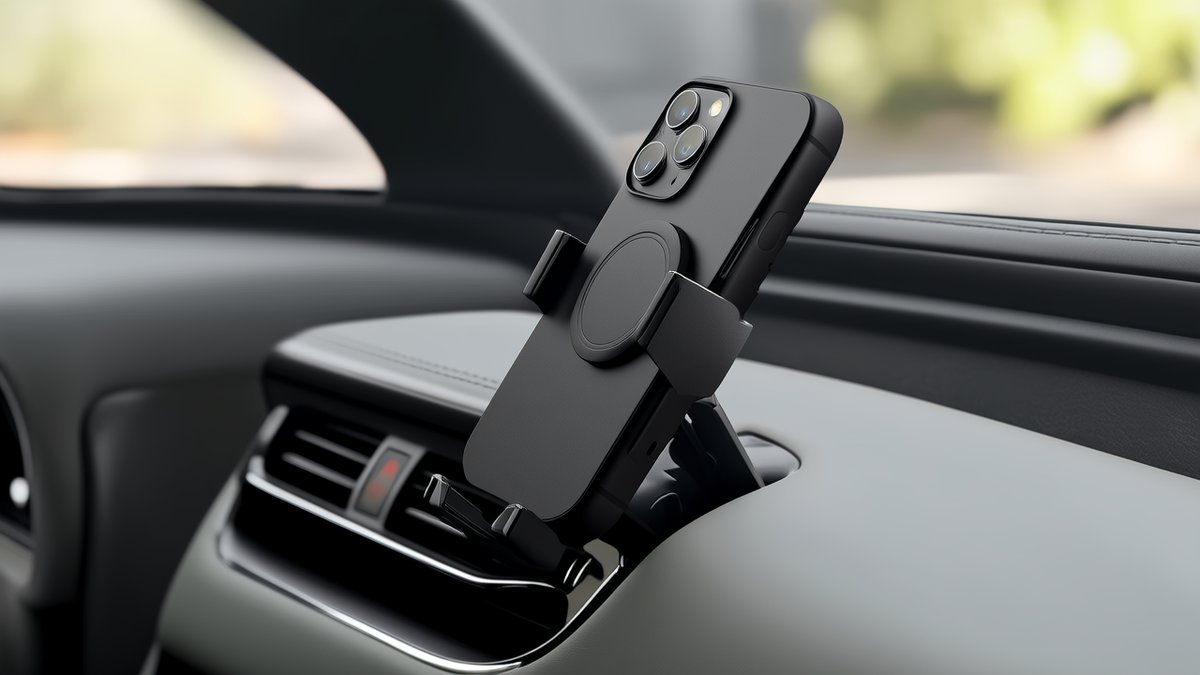
The appeal of a magnetic mount is that the magnet does the alignment for you. The catch is that the phone has to have magnets. Samsung now lists its Magnet Wireless Charger (EP-P2900) as a Qi2.2 accessory with up to 25W output, but the compatibility wording points buyers toward an official Qi2-ready magnetic case rather than promising that every S26 snaps on by itself. In other words, built-in magnets on Android phones are still not a default.
So check which category your phone falls into before buying anything:
- Built-in magnet array (iPhone 12 and later, plus a handful of MPP-certified Android models): a magnetic mount just works, and it is the easiest to dock and remove.
- Magnet added by a case: fine, if the case is right. Shift the ring a little and coupling drops; a product rated at 25W may only deliver around 10W.
- Clamp arms only: now the mechanical design decides. Clamping force, spring fatigue, and whether the vent louver holds the phone plus case without sagging.
Vent mounts have another problem people forget. Cold air in summer looks like free cooling, but in winter that same vent pushes warm air straight onto the back of the phone.
2. Thermals decide how long 25W actually lasts
At 25W most of the heat is generated in the air gap between the transmitter coil and the receiver. Since IFA this year the visible trend has been head brands moving active cooling into chargers and magnetic power banks. Anker's MagGo 2 Pro pairs a fan, two air channels and a three-layer graphene stack, with company testing citing a back surface below 36 degrees Celsius and an SGS performance mark. Belkin and UGREEN have brought semi-solid-state cells and liquid cooling into the same conversation.
Keep one thing in mind: 36 degrees is a surface reading under the manufacturer's own test conditions, not a promise about your phone. The same material notes that the handset runs its own thermal controls and will reduce what it accepts when the surroundings get hot. The classic car scenario is a mount with a working fan and a phone that throttles itself anyway, because the screen is on and navigation is running.
What helps in practice is unglamorous. Move the charging spot out of direct sun, avoid running navigation and a hotspot at full tilt while charging, and prefer a mount that shows temperature over one that only prints wattage.
Then there is power. A steady 25W needs a 12V socket run that can carry it, and on USB-C it needs the right PD tier and a cable to match. An old 18W adapter will not feed a 25W pad.
The short version: an in-car charger is a matched system, not a number. Confirm how the phone attaches and how the mount holds, then check cooling and power, and only then worry about the 25W.
© SWPO. All rights reserved.