
Walk into a 2026 showroom and wireless charging has quietly moved from the options sheet to the standard column. The 2026 Tesla Model Y lists its 15W front pad as standard equipment, and the Rivian R1T puts a Qi pad in the base center console. Reviewers comparing these cars now treat it as something a car should have rather than a bonus.
The supply chain tells the same story. On the OEM purchasing side, wireless charging was roughly an $18.4 billion business in 2026, with automotive the fastest-growing slice at about 46.7% compound growth; close to 70% of new WPC certifications now land in the 25W tier, which means the category's centre of gravity for new products has moved off 5W and 7.5W.
Three Things Changed On the Pad Itself
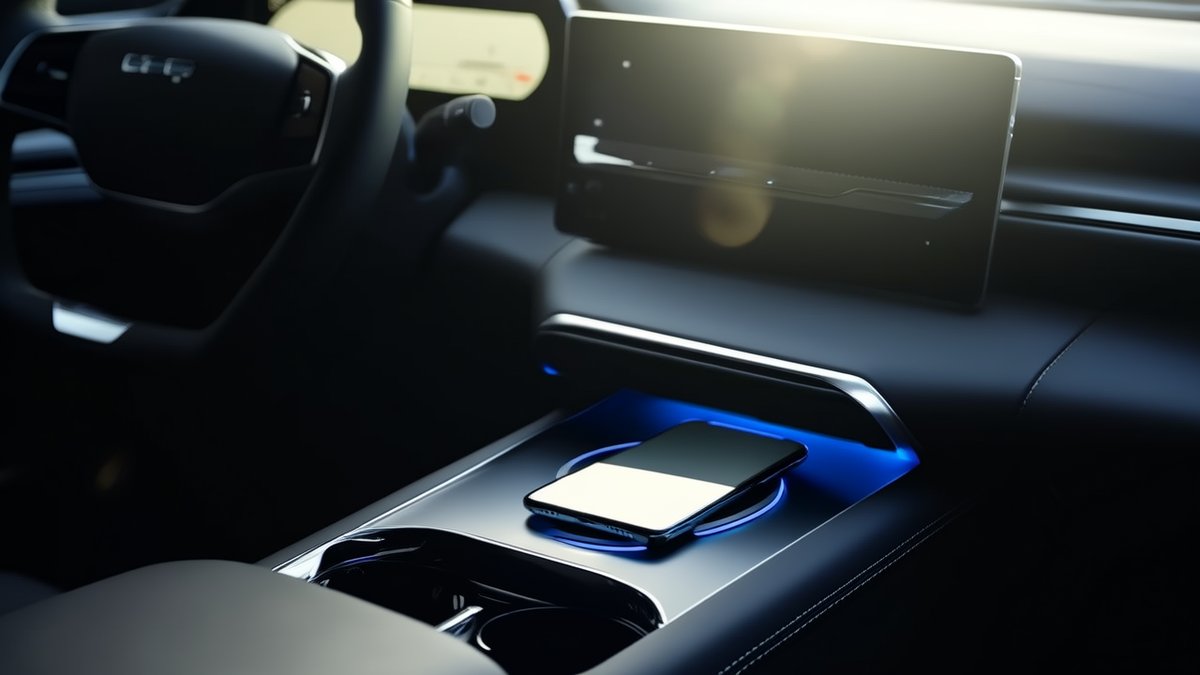
Magnet alignment comes first. The old complaint about in-car charging was a phone that looked like it was charging but sat off-centre. Magnets turn that from a matter of feel into a matter of geometry: a ring in the phone, a ring in the pad, and 25W only when the two line up. Foreign object detection is the second. Cars are harsher than desks, and coins, cards and keys end up in the recess, so 2026 automaker specs generally treat FOD as a required test, cutting power or shutting down when metal is detected. Standby power is the third. A new Chinese efficiency standard pushes in-car wireless charging below 0.5W at idle, a number nearly invisible to drivers but mandatory in an automaker's energy ledger.
Power Climbed, and the Rules Arrived First
On power, China raised the rated limit for wireless charging equipment from 50W to 80W in September 2024, opening a legal path for 50W and higher inside the cabin. The matching communication standards GB/T 38775.9-2025 and GB/T 38775.10-2025 took effect on 1 July 2026, covering the application and data-link layers between the on-board charger and wireless charging equipment along with conformance testing, while T/CAMAA 039-2026 in March 2026 sharpened the technical requirements for in-car wireless charging terminals. Abroad, SAE J2954 governs ground-pad systems for light-duty vehicles up to 11 kW, a different problem from charging a phone even though the two share a name. Tesla bought German wireless charging firm Wiferion in 2023 and later disposed of the assets, and still sells no production inductive pad, which says high-power EV charging stays far from consumers.
Keep the two apart. A phone pad runs from 15W to 50W on Qi and Qi2 magnetic profiles, which are consumer standards; vehicle charging is measured in kilowatts and follows industrial ones. What actually changed in 2026 is the first one becoming standard equipment.
For accessory makers the opening is not another 15W plate. It is the aftermarket, where plenty of cars on the road are still 5W or 7.5W and a magnetic pad is an easy upgrade, and it is the parts around it, from magnetic cases and ring stickers to mounts that survive surface temperatures above 40°C. For buyers, do not stop at the wattage. Check three things: does the pad carry a magnet ring, does the spec sheet mention FOD, and does anything state 25W. All three, and it is a car built to the 2026 baseline.
© SWPO. All rights reserved.