
The thing that limits how thin a magnetic power bank can get is not the shell but the cell inside it. Graphite anodes have a theoretical capacity of 372 mAh/g, and for twenty years that number carried nearly every phone and power bank on the market. It is now pressed against its ceiling. Silicon reaches 4,200 mAh/g, more than eleven times higher, and the catch is that it swells by as much as 300% while charging. The industry settled on a compromise: keep the carbon, blend in a controlled amount of silicon, and ship a silicon-carbon composite anode.
That road has reached the consumer shelf. One of the ultrathin magnetic power banks on sale now puts a 5,000mAh cell into a body 6mm thick and 98 grams light. Snapped on magnetically it delivers 15W to its own brand's phones, is capped at 7.5W on iPhone by Apple's MagSafe spec, and still carries a 22.5W USB-C port for a second device. Tear-down reporting puts the cell at roughly 16% silicon content and 18.58Wh; the same capacity on a conventional graphite anode would need 20% to 40% more thickness. That gap is the entire product.
The energy density ledger, counted in Wh/L
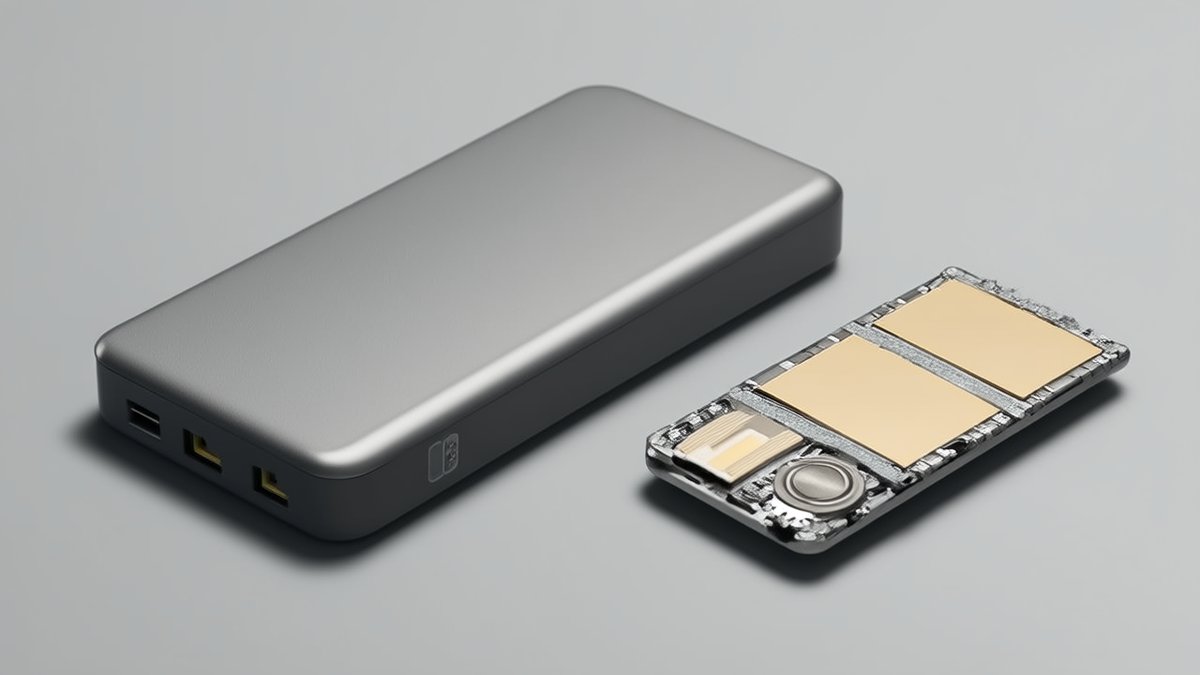
The power bank trade quotes mAh, but volume is set by volumetric energy density. A common 18650 cylindrical cell sits around 450 to 500 Wh/L, a 21700 runs 550 to 600 Wh/L, ordinary polymer pouches land at 400 to 480 Wh/L, and silicon-carbon polymer cells reach 650 to 750 Wh/L. On a weight basis, commercial silicon-carbon cells are now landing in the 300 to 400 Wh/kg range against roughly 200 to 250 Wh/kg for the graphite cells that powered the last decade. The cost line is equally clear: silicon-carbon runs 30% to 50% above graphite.
No single company owns the approach. CUKTECH fits a 15,000mAh silicon-carbon cell into a body 2.1cm thick, and Nitecore's NB10000 uses the same chemistry for an IPX7 outdoor brick. When several companies chasing entirely different customers converge on one anode material within a few months, it usually means the process just cleared its mass-production cost threshold. Upstream, the same shift shows: in April 2026 CATL's third-generation Kirin condensed-matter battery reached over 350 Wh/kg at cell level using a low-expansion silicon-carbon anode. Analyst comparisons put silicon-carbon composites at 320 to 380 Wh/kg and silicon-dominant anodes above 400 Wh/kg.
Where the bill shows up: cycle life, swelling control and heat
That 300% volume swing is not a footnote. It cracks particles, breaks electrical contact with the current collector, and makes the SEI passivation layer on the anode surface crack and rebuild every cycle, consuming usable lithium and dropping capacity. The industry counters on three fronts: shrinking silicon to nanoscale, using carbon coatings and buffer voids to give expansion somewhere to go, and pre-lithiation to replace the lithium lost in the first cycle. CVD deposition is the mainstream route for silicon-carbon today because it controls silicon content and distribution fairly precisely.
The trade-offs land on the spec sheet. Graphite anode cells typically cycle 1,500 to 3,000 times, silicon-carbon composites 800 to 1,500 times, and silicon-dominant anodes less. The good news is that the composite structure often runs cooler than pure graphite at the same output, because less material is fighting the current. That is part of why an ultrathin magnetic power bank is comfortable rating 22.5W over USB-C. The carbon matrix also compensates for silicon's semiconductor nature; without it, silicon's poor electron transport would drag down rate performance.
Back to shopping. Do not stop at the 10,000mAh figure on the listing. That is usually cell capacity, and the rated capacity that actually comes out of the USB port is typically 5,500 to 6,500mAh. The same reading applies to magnetic power banks: thin and light is what silicon-carbon gives you, and cycle life and price are what it charges you. For someone replacing a power bank every two or three years that trade is worth it. For someone planning to keep one for five, it is worth thinking through first.
© SWPO. All rights reserved.