
You buy a magnetic charging pad rated 25W, plug it in, and the phone shows 15W. On a bad day it drops to 7.5W. The instinct is to blame the pad. Most of the time the pad is telling the truth. What is holding you back sits on the wall.
Power clears three gates on its way to the battery: the adapter has to supply it, the transmitter has to turn it into a magnetic field, and the phone's receiver has to accept it. Two of those gates live on the charger side, but half of the decision is made at the plug.
Under Qi2.2, officially Qi v2.2.1 and published by the Wireless Power Consortium on 23 July 2025, reaching 25W calls for a USB-C PD adapter of at least 30W. That 30W is not marketing headroom; it falls straight out of the voltage rails. Apple states the condition plainly: a MagSafe charger reaches 25W only with an adapter rated 15V/2.0A or higher, which means 30W and up. Japanese brands often ask for more. The Elecom W-MA12 series and UGREEN MagFlow both specify a 45W-or-higher PD brick for full 25W, and Elecom says even 15W needs 30W. The 20W adapter in your phone box clears neither bar.
StarTech's spec sheet for its Qi2.2 25W pad says it without decoration: 5V/9V/12V/15V input, 3A maximum input current, 25W maximum output, plus a line telling buyers to use a 30W USB-C PD charger because lower-wattage adapters will limit the maximum wireless output. That line is the whole answer.
Why the 15V Rail and Not 9V
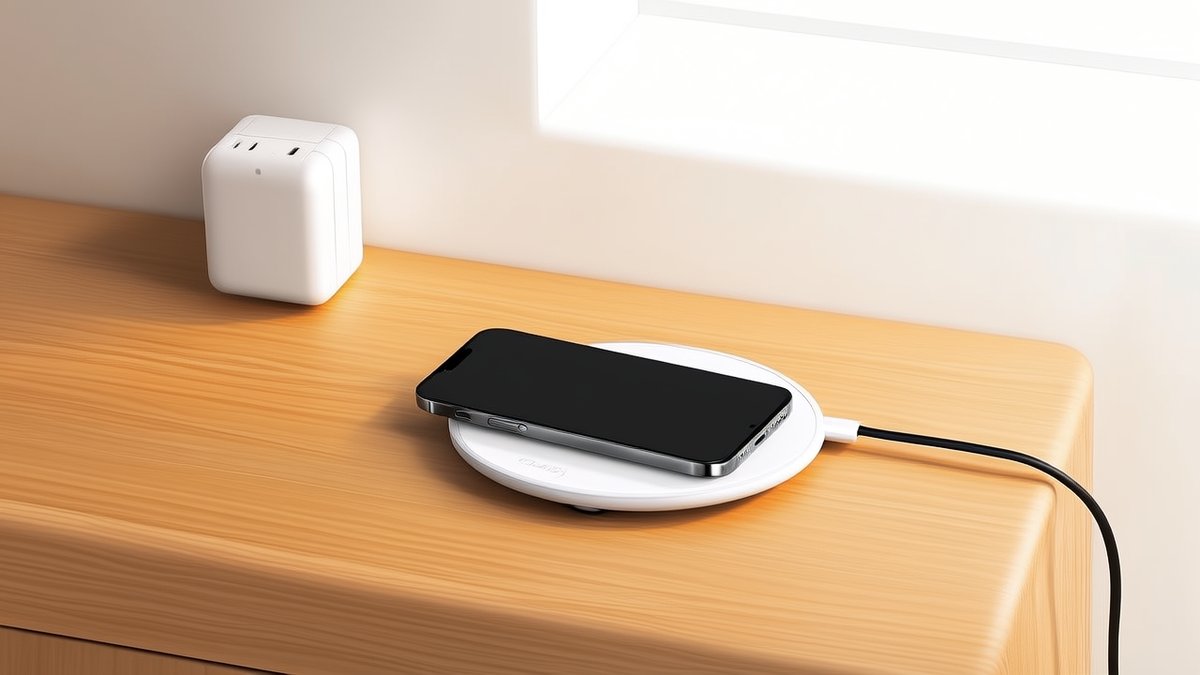
USB-C PD negotiates through a short list of rails: 5V, 9V, 12V, 15V, 20V. A 20W brick usually offers only 5V/3A and 9V/2.22A, topping out at 9V. A charging pad running at full tilt generally wants to pull from 12V or 15V. The reason is ohmic. Delivering 25W at 15V draws about 1.7A, while the same 25W at 9V draws close to 2.8A. Copper loss scales with the square of current, so nearly doubling the current roughly quadruples the heat in the coil and the wiring. That is not academic. Qi2.2 caps the charging surface at 40°C, and the extra heat is often the thing that pushes it over.
A 20W adapter cannot even negotiate a 12V rail. The transmitter falls back to 9V, output settles at 15W. There is a second trap that gets missed: older bricks that only speak Quick Charge or a proprietary protocol will hand a USB-C cable just 5V/2A or 9V/2A. Same cable, half the power.
The speed gap is easy to see. In Elecdov's testing, an iPhone 17 Pro went from 0 to 50% in 29 minutes on Qi2.2 25W magnetic charging, with a 38°C peak. Conventional Qi2 at 15W takes 45 minutes. Qi 7.5W takes 85. So the buyer pays for 25W, keeps a 20W brick, and lives with a 15W experience at roughly double the time.
Cables belong to the same chain. Manufacturers now tell you to check the length and rating of the cable bundled with the charger, because an under-rated cable limits output. A USB-C cable needs to carry 3A, the 60W class, and the cable in the phone box usually qualifies. Swap in a cheap long cable, or an older 2A one, and the rail will not come up.
Do the Multiplication Before You Buy
Start with the input wattage the pad asks for, then count how many devices will charge at once. Elecdov's configuration table is a clean template: phone only at 25W wants a 30W PD minimum with 45W recommended; a 3-in-1 for phone, watch and earbuds wants 45W minimum with 65W recommended; add a tablet for 4-in-1 and it becomes 65W minimum with 100W recommended. The logic is simple. Feed a 3-in-1 from a 45W brick that cannot keep up and each device may see only 15W.
Second, check what your phone will actually accept.
- The newest flagships mostly reach 25W. The iPhone 18 Pro series runs 25W over MagSafe and Qi2.2, capped at 15W on China-market units, and the iPhone 17 Pro, 17 Pro Max, 17, 16 Plus and 16 Pro Max all reach 25W. Samsung's Galaxy S26 Ultra measured 0 to 50% in 28 minutes on Qi2.2 MPP, essentially matching Samsung's own 25W wireless.
- The iPhone Air caps at 20W and the iPhone 16 and 16 Pro at 22.5W, while the iPhone 17e and everything back to the iPhone 15 stays at 15W. Pairing those phones with a 25W pad and a 30W brick buys you nothing.
- On Android the case still decides. Phones without a magnet ring in the body need a magnetic case or careful manual alignment, and a pad that grabs off-centre falls back to 15W or less.
Third, confirm the brick actually offers a 15V rail. Two 30W or 45W PD adapters can carry different rail tables, so reading the voltage list on the box beats reading the headline wattage.
Put simply, wireless charging power is not one product's job. The pad states the ceiling; the brick on the wall decides whether you ever touch it. Next time something feels slow, try another adapter before you try another charger.
© SWPO. All rights reserved.