
In September 2026, a Chinese robotics company began shipping its consumer companion humanoid, against 13,361 orders booked by its June 30 launch and price tags running from about $16,500 to nearly $136,000. One line in the spec sheet matters more than the price: an 8,100mAh battery, two to four hours of runtime per charge, roughly 1.5 to 2 hours to refill, and up to 2,070 TOPS of on-device compute in the top configuration.
Read those three numbers together and the real position of this product class becomes clear. An 8,100mAh pack at a nominal 3.85V works out to about 31Wh; spread over three hours, the whole machine averages under 11W. That single budget has to feed three things at once: moving the body (88 degrees of freedom, more than 60 of them active on the high-end version), running the emotion model locally, and holding skin temperature near the human range.
Why the model has to live inside the body
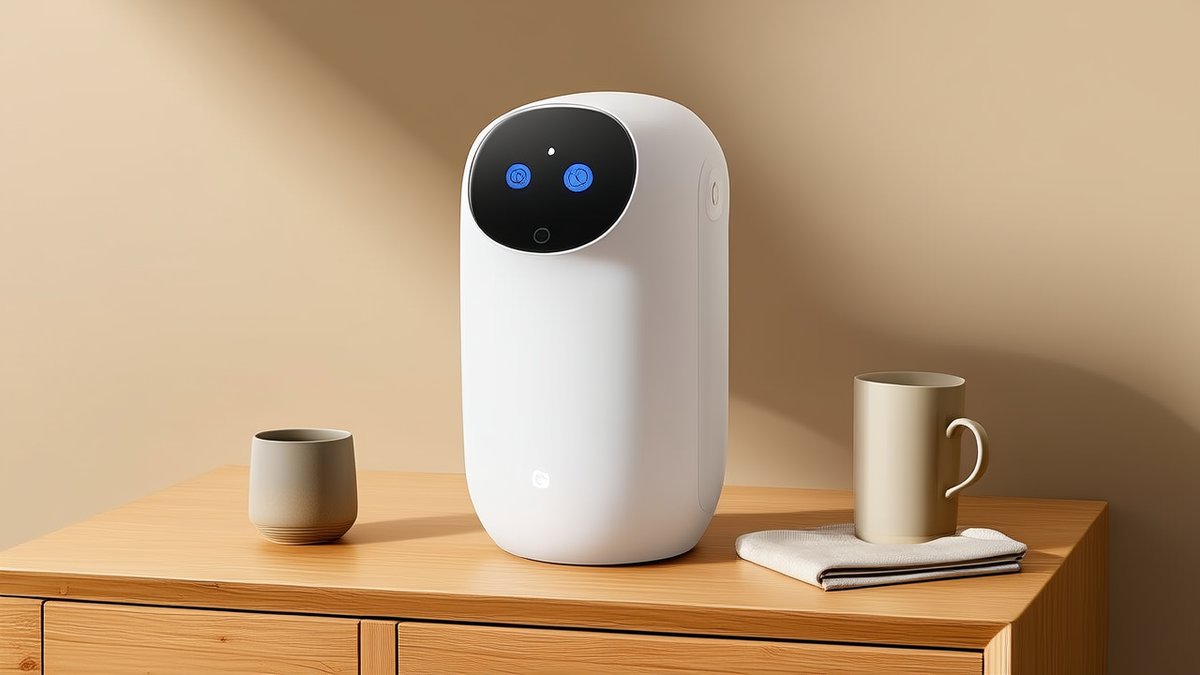
Latency first. The published figure for voice-to-lip-sync is under 20 milliseconds, backed by a two-tier design that pairs roughly 500ms instinctive reactions with heavier deep reasoning. Neither tier survives a cloud round trip — one hop costs tens to hundreds of milliseconds, and that assumes an uncongested network.
Privacy is the second reason. A headline feature of these robots is that interaction data is encrypted and stored locally by default, with no mandatory cloud upload. For the buyer, that is not a technical detail. It is the precondition for putting the thing in a bedroom.
The cost of local inference is concrete, though. In a March 2026 cross-platform study, the same 4-bit quantized 1.5B model answering the same 258-token prompt ran at 131.7 tokens per second on a laptop RTX 4050 — at 34.1W on the GPU alone — against 23.7 tokens per second on an iPhone 16 Pro in a heat-soaked state, 10.4 tokens per second on a Galaxy S24 Ultra at about 1.5W, and 6.9 tokens per second on a Raspberry Pi 5 with a Hailo-10H accelerator at 1.87W for the whole board. The gap is not about benchmark scores. It is about what fits inside a battery. Meta framed the practical test in January 2026: a model that drains your battery or triggers thermal throttling is not usable, however good it scores.
TOPS sells the sheet; the power budget sets the ceiling
The 2,070 TOPS figure is the easy one to market. Worth noting: the same number appears on NVIDIA's Jetson Thor T5000 module, at 2,070 FP4 TFLOPS — except that is a part configurable between 40W and 130W, an order of magnitude above this robot's average draw. The interesting question is not the peak. It is how much of that compute is actually awake, running what size of model, and when thermal throttling starts.
What fits a battery-powered product looks different. A dedicated accelerator such as the Hailo-10H — 40 TOPS INT8 under a 3W ceiling — runs Qwen2-1.5B-Instruct at 9.45 tokens per second at about 2.1W average. Unimpressive on a desk, workable inside an embedded device. The metric that matters at the edge is not tokens per second but joules per token at a fixed thermal design point, and generation speed is usually set by memory bandwidth rather than capacity. That is why, in this class of hardware, a small model on a fixed-function NPU tends to beat a large model on a GPU.
The problem only tightens further down the range. Desktop AI companions and AI toys carry smaller batteries and tighter cost targets, so the models inside them get smaller still — and the details of quantization, KV cache and wake-up strategy decide how good the experience actually is.
There is one more line item people miss: the hardware is only the entry ticket. Once memory and emotional continuity live on the device — and a subscription is tied to them — recurring revenue becomes the real business. One vendor charges $199.99 a month for its robot controller AI service; another lists $20,000 for early access or $499 a month. Before buying, ask two questions: which features keep working offline, and what is left after the subscription lapses.
In the end, this category will not be decided by a TOPS number. It will be decided by whether the power budget adds up. How long the battery lasts is how long it stays in the house.
© SWPO. All rights reserved.